


What Are FEFCO Codes? A Complete Guide to Corrugated Box Standards
Understanding what FEFCO codes are and how they work is the foundation of every corrugated packaging decision. Every corrugated box manufactured anywhere in the world can be described by a four-digit number, which is the power of the FEFCO code system, a universal globally recognised corrugated box engineering language that helps to prevent specification errors through common box style codes.
Most procurement teams encounter these codes without fully understanding how choosing the right one affects transit damage rates, packing line speed, and total logistics cost.
Manor Packaging, an independent UK manufacturer operating from a 61,598 sq ft facility in Whittlesey, Peterborough, holds BSI ISO 9001:2015 and ISO 14001 accreditation and, with over 35 years’ trading experience in the group, works daily with the FEFCO 12th Edition (2022) design library to engineer bespoke solutions that integrate directly into automated supply chains and manual packing assembly lines.
This article covers every FEFCO series, the most commonly used codes in UK manufacturing, how material grade interacts with structural design, and how our consultative process turns code selection into a measurable performance improvement.
What Are FEFCO Codes and Where Do They Come From?
A FEFCO code is a four-digit numerical identifier assigned to a specific corrugated packaging structure by the European Federation of Corrugated Board Manufacturers, originally the Fédération Européenne des Fabricants de Carton Ondulé.
The code defines structural geometry: flap configuration, joint type, and assembly method. It is the starting point for every packaging design conversation, not a final answer.
The Origins of the FEFCO System
Before the FEFCO code system was introduced in the late 1960s, box constructions were described using long, ambiguous verbal descriptions that varied by country and manufacturer, causing production errors and friction in cross-border trade. A numerical system replaced that ambiguity with mathematical precision.
The FEFCO 12th Edition (2022) is the current authoritative standard. It incorporates over 100 new designs compared to its predecessor, reflecting e-commerce growth, retail-ready requirements, and sustainability mandates. The FEFCO International Code (fefco.org) is freely accessible and forms the reference point for every structural specification we produce.
How the Four-Digit Code Structure Works
The first two digits identify the basic design category. The final two specify the unique variation within that category. 02 denotes slotted and creased type boxes; 0201 sets out the Regular Slotted Container within that series.
The International Corrugated Case Association (ICCA) has adopted the FEFCO-ESBO code as the global benchmark, meaning that a code specified at our Whittlesey facility is understood with identical precision by manufacturers worldwide. Bespoke hybrid codes, such as a 0204/0215 top-and-bottom-flap combination, extend the system to applications beyond the standard catalogue.
A common assumption is that FEFCO codes are simply a naming convention for ordering corrugated boxes. They are not. The four-digit code encodes structural geometry that directly determines whether a box can be erected by automated packing equipment.
Specifying a code without understanding its assembly geometry can result in a box that physically cannot run on a client’s automated line, causing unplanned downtime and emergency retooling costs that dwarf any savings made on unit price.
At Manor Packaging, we treat each code as a framework we engineer around product dimensions, transit conditions, and packing line requirements.

The Complete FEFCO Series: From 0100 Sheets to 0900 Fitments
The FEFCO system covers nine series, each serving a distinct function in the logistics cycle.
Series 0100 to 0400: Sheets, Slotted Boxes, Telescopes, and Folders
FEFCO 0110 refers to corrugated sheet cuts used as pallet bases, interlayer sheets between stacked products, and top sheets for load protection during transit. These sheets are also the raw material input for die-cut packaging production.
The 0200 series, slotted-type boxes, is the primary tool of global shipping. FEFCO 0201 (the Regular Slotted Container, or RSC) features flaps that meet in the middle and is the most widely used packaging design in existence. FEFCO 0202 uses partially overlapping flaps for added structural integrity.
FEFCO 0203 uses full-overlap flaps, creating multiple protective layers at top and bottom, making it the preferred choice for heavy or fragile goods where point-load crushing during palletised transit is a risk. FEFCO 0215 (the Swedish bottom or envelope base as it is commonly known) allows rapid manual assembly without tape, increasing throughput on medium-volume packing lines.
The 0300 series (telescope-type boxes) uses a base and lid that slides over it, doubling vertical wall thickness and delivering superior stacking strength. The 0400 series (folder-type) produces single-piece die-cut designs with self-locking tabs.
FEFCO 0427 is a premium e-commerce mailer with double-thickness side walls and ear-lock tabs requiring no tape or glue for closure. This is commonly used as the template to designing bespoke ecommerce boxes, unique to the customer.
Series 0500 to 0900: Slide Types, Rigid Cases, Ready-Glued, Retail, and Interior Fitments
The 0500 series (slide-type) uses sleeves and liners that slide into each other, commonly specified for small retail items. The 0600 series (rigid-type) joins two end pieces and a central body with stitching or heavy-duty adhesive and is used for heavy industrial components requiring a non-collapsible structure.
The 0700 series (ready-glued) delivers pre-glued boxes that erect in seconds. FEFCO 0713 (crash-lock glued box) is the preferred choice for high-volume fulfilment centres where assembly speed drives operational efficiency. The 0800 series covers retail and shelf-ready packaging (SRP/RRP), satisfying the industry-defined “five easies”: easy to identify, open, shelf, access, and recycle.
The 0900 series defines interior fitments, including dividers, partitions, and pads, that replace plastic-based void fill and create 100% paper-based mono-material packaging solutions.
Our structural design team works across all nine FEFCO series, selecting and modifying the most appropriate style for product weight, transit route, and packing environment, whether that is a high-volume standard shipping carton or a precision-engineered e-commerce mailer.
Which FEFCO Codes Are Most Commonly Used in UK Manufacturing?
The right FEFCO code is never determined by the box alone. It is determined by the interaction between product weight, transit distance, packing line configuration, end-destination handling conditions and crucially, the customer aesthetic and opening experience.
FEFCO 0201: The Industry Workhorse
FEFCO 0201 (RSC) is the default transit box for the majority of UK manufacturing and distribution operations. Its simplicity makes it cost-effective at high volumes, but its generic geometry often results in it being oversized for the products it carries, shipping unnecessary air and increasing courier costs. Right-sizing a 0201 through CAD design is one of the fastest routes to measurable cost reduction in a packaging programme.
FEFCO 0427 and the E-Commerce Shift
FEFCO 0427 has become the go-to structure for premium e-commerce and direct-to-consumer (D2C) fulfilment. Its double-thickness walls and self-locking ear tabs mean no tape is required, reducing assembly time and eliminating plastic tape from the packaging footprint.
For brands where the unboxing experience matters, the 0427 also provides a flat, smooth panel surface well suited to high-quality print, enhancing the opening experience and often conveying brand identity.
FEFCO 0713: The Crash-Lock Advantage
FEFCO Style 0713 (Crash Lock Glued Box) has transformed high-volume packing lines. The crash-lock glued base erects in a single downward movement, reducing assembly time by over 50% compared to a standard bottom-taped 0201.
A pre-glued crash-lock base is still tamper evident and also eliminates the variability introduced by manual bottom-taping, where tape application quality depends on operator attention and fatigue. Inconsistently taped 0201 bases are a leading cause of base failure during palletised transit, resulting in product damage claims and retailer chargebacks that a crash-lock glued base prevents entirely.
The FEFCO 12th Edition (2022) includes hybrid code combinations such as 0204/0215 configurations for bespoke modifications beyond standard catalogue styles. When businesses are unsure which FEFCO style suits their operation, our team conducts a structured packaging review before recommending the most cost-efficient code for the specific application.
How Flute Grade and Material Selection Interact With FEFCO Codes
FEFCO codes define structural geometry only. Two corrugated boxes with identical FEFCO 0201 codes can have entirely different performance characteristics depending on whether they are made from E-Flute, B-Flute single wall, EB or BC-Flute double wall board.
E-Flute, B-Flute Single Wall, and EB or BC-Flute Double Wall: Choosing the Right Board
E-Flute (around 1.5mm thick) provides an exceptionally smooth printing surface, ideal for premium e-commerce mailers and retail packaging, but offers lower stacking strength than B or BC.
B-Flute (around 3mm thick) is the standard workhorse for transit boxes, offering a balance of cushioning, stacking strength, and cost-effectiveness. It is the default choice for FEFCO 0201 and 0203 applications across most UK manufacturing sectors.
EB-Flute (double-wall, around 5mm thick) combines an E-Flute and B-Flute ideally suited to high quality print as well as delivering maximum compression strength and puncture resistance. It is the double wall material of choice for most printers in the UK. At Manor Packaging they have the capability to manufacture at high speed EB crash lock glued boxes. Often for the ecommerce industry or high end protective packaging sectors.
BC-Flute (double-wall, around 6mm thick) combines a B-Flute and C-Flute layer to deliver maximum compression strength and puncture resistance. It is specified for heavy industrial components, machinery parts, and export shipments where extended transit times and rough handling are expected.
Why Material Grade Is Not Encoded in the FEFCO Style
Upgrading from B-Flute to BC-Flute on a standard FEFCO 0201 doesn’t automatically improve performance. If not designed correctly, BC-Flute’s 6mm wall thickness reduces internal usable dimensions by around 10mm per wall pair on a standard 0201 footprint.
Businesses that specify BC-Flute without recalculating the scored dimensions end up with corrugated boxes where the product either doesn’t fit or can shift during transit, negating the stacking strength benefit and increasing damage rates, while paying a material cost premium that delivers little net protection.
All board grades we supply are FSC®-certified (C115460). The corrugated sheet board used in our production is manufactured through a carbon-neutral process at CorrBoard UK, the UK’s only carbon-neutral corrugated sheet plant. Our structural designers specify the correct flute grade alongside the FEFCO code, using CAD modelling to deliver the required compression strength, print quality, and dimensional accuracy for each product and transit route.
Die-Cut FEFCO Styles: When Standard Slotted Designs Are Not Enough
Slotted-type boxes in the 0200 series can be manufactured on high speed case-making machinery. The more complex FEFCO styles, particularly the 0400 folder series, 0700 ready-glued series, and bespoke hybrid codes, require die-cutting to achieve their precise cutting and creasing, self-locking tabs, perforations, and unique shapes.
What Makes a FEFCO Code a Die-Cut Design?
Die-cutting uses a shaped steel rule tool pressed into the corrugated board to cut and crease simultaneously, enabling geometries impossible to achieve with straight-line slotting equipment. The FEFCO 0427 e-commerce mailer requires die-cut ear-lock tabs and precise crease lines that allow the box to fold flat for storage and erect cleanly without tape. The tolerances demand millimetre-level accuracy across every unit in a production run to insure trouble free assembly.
A common assumption is that die-cut FEFCO styles are relevant only to retail or branded packaging. In automated production environments, robotic erectors need consistent crease-line depth that standard slotted production cannot hold at scale. When crease-line depth and position varies across a run, boxes don’t square up correctly during erection, a condition known as “fishtailing”, causing machine jams, throughput loss, and production costs that accumulate significantly over a full operating year.
When specifying FEFCO packaging for automated lines, the precision of die-cut crease geometry is not a cosmetic consideration. It is a throughput requirement.
Precision Manufacturing for Complex Corrugated Structures
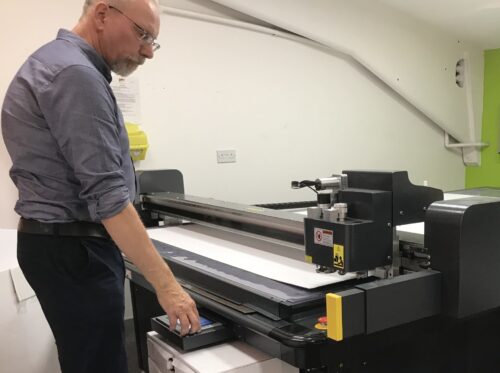
Our AG CAD Sample Table allows rapid prototyping of new die-cut FEFCO styles without the lead time or cost of traditional metal die tooling, which is key for businesses launching new product lines or testing packaging modifications before committing to full production volumes.
Our TCY Rotary Diecutters handle large-format die-cut container styles, minimising board waste and maintaining consistent score-line depth across high-volume runs. Our Vega Altair 240 Multipoint Gluer and Bobst Expertfold 165 Multipoint Gluer apply precise adhesive patterns to ready-glued 0700-series styles, so crash-lock bases perform reliably at the packing line.
FEFCO Codes, Sustainability, and Compliance Requirements
The choice of FEFCO code has direct implications for compliance with the Extended Producer Responsibility (EPR) regulations. Manor Packaging specialise in providing solutions to minimise your EPR obligations through clever bespoke designs and material choices.
How FEFCO Box Design Supports Plastic Reduction Targets
The FEFCO code determines whether a packaging solution is mono-material (box and fitments all corrugated) or mixed-material (corrugated box with plastic-based void fill or foam inserts). Mixed-material packaging is significantly harder for end-consumers to recycle and increases a brand’s EPR reporting obligations.
Businesses that specify a FEFCO 0201 with plastic-based void fill, when an engineered 0900-series corrugated fitment would perform equally well, are accumulating EPR compliance costs that compound as fee structures tighten through 2025 and beyond. Corrugated cardboard swiftly biodegrades compared to centuries for most plastics, and a mono-material corrugated solution simplifies end-of-life recycling directly, including kerbside recycling.
Carbon-Neutral Board Manufacturing and Scope 3 Emissions
FEFCO sustainability data (fefco.org) confirms that the average carbon footprint for corrugated board has been reduced to 491 kg CO2-eq per tonne, a measurable benchmark businesses can reference in their Scope 3 emissions reporting.
Our part-ownership of CorrBoard UK means the board used in our FEFCO box production is manufactured using energy generated by an on-site Anaerobic Digestion (AD) plant, creating a circular energy loop from organic waste to green power. All board grades carry FSC® certification (C115460). Our Whittlesey factory is powered by 50% rooftop solar energy, and we hold ISO 14001 Environmental Management accreditation. Our Carbon Net Zero target for Scopes 1 and 2 by 2030 means that clients choosing Manor Packaging align with a supply chain partner with a specific, verified emissions-reduction commitment.
Choosing the Right FEFCO Style: Our Consultative Design Process
Selecting a FEFCO code is the beginning of the design process, not the end. The most significant cost inefficiencies, including oversized boxes shipping air, suboptimal pallet fill rates, and FEFCO styles that slow packing line throughput, are invisible in day-to-day operations because they are absorbed into logistics and labour budgets.
Businesses that don’t audit their box range and FEFCO specifications against fresh new ideas are typically paying more in total packaging and carriage costs than an optimised box specification would require.
From Code Selection to Production: How We Engineer Your Packaging
Our structural designers use CAD modelling to right-size standard FEFCO templates to exact product dimensions, eliminating excess void space that inflates courier costs and increases product movement during transit. Reducing outer box dimensions by even a small margin can move a parcel into a lower courier tariff bracket, and those savings compound significantly over high-volume runs.
Pallet optimisation through precise dimensional engineering reduces vehicle movements, fuel consumption, and carriage costs across a full year’s volume.
Our free packaging audit gives businesses a structured review of their current corrugated packaging, examining FEFCO style, board grade, dimensions, and packing line compatibility, to identify specific opportunities to reduce material cost, improve transit performance, or increase packing speed.
Supply Chain Reliability and Just-In-Time Delivery
For clients requiring a consistent supply, our Stock and Serve/Just-In-Time (JIT) delivery programme maintains agreed stock volumes in our 43,000 sq ft dedicated warehouse. Our OTIF delivery performance of 96% to 98.5%, supported by our own transport fleet with 30% rolling capacity headroom, minimises the risk of supply disruption even during peak seasonal demand periods or times of market disruptions (the Covid period).
Manor Packaging was established in 1987, with the Fencor Packaging Group formed in 1999. With a minority shareholding by VPK Group, one of Europe’s largest corrugated manufacturers, alongside our part-ownership of CorrBoard UK, Manor Packaging provides security of raw material supply that is a direct differentiator when board availability tightens across the market.
Request your free packaging audit from Manor Packaging in Whittlesey. Our structural design team will review current FEFCO specifications, identify cost and performance improvements, and provide a written recommendation with no obligation.
Frequently Asked Questions
What Is the FEFCO Code?
A FEFCO code is a four-digit numerical identifier assigned to a corrugated packaging structure by the European Federation of Corrugated Board Manufacturers. The first two digits identify the design series, and the last two specify the style within it. The FEFCO 12th Edition (2022) is the current standard. Codes define structural geometry only, not board grade or material specification.
What Is FEFCO Code 0201?
FEFCO 0201 is a slotted and creased type box with meeting flaps on both top and bottom, creating multiple board layers at the closure points for superior cushioning and stacking strength. It’s often the go to preferred choice for heavy or fragile goods where point-load crushing during palletised transit is a risk. B-Flute and BC-Flute are the typical board grades specified for this style.
What Is FEFCO Code 0216?
FEFCO 0216 is a variation within the 0200 slotted series with a flap configuration that provides additional base strength. It suits applications where a reinforced base is needed without the full material cost of a double-wall board upgrade. A structural packaging designer can confirm whether 0216 or a board grade change is the more cost-effective solution for a specific application.
What Is FEFCO Code 0110?
FEFCO 0110 refers to corrugated sheet cuts, flat sheets used as pallet bases, interlayer sheets between stacked products, and top sheets for load protection during transit. They’re also the raw material input for die-cut packaging production. E-Flute, B-Flute, and BC-Flute grades are all available depending on the load protection requirement.
How Do I Choose the Right FEFCO Style for My Product?
The correct FEFCO codes depend on four factors: product weight and fragility, transit route and handling conditions, packing line configuration (manual or automated), and end-destination requirements. A structured packaging audit is the most reliable method. Manor Packaging offers a free packaging audit as a practical starting point for businesses reviewing their corrugated specifications.
Are FEFCO Codes the Same as Box Dimensions?
No. FEFCO codes define structural geometry, including shape, flap configuration, and assembly method, not dimensions. Length, width, and depth are specified separately and customised within any FEFCO style. Right-sizing corrugated boxes through CAD design affects courier postal costs, pallet fill rates, and product protection independently of the code selected.